Honda C0062-F0 Code: Ultimate Guide to Causes, Symptoms & Fixes
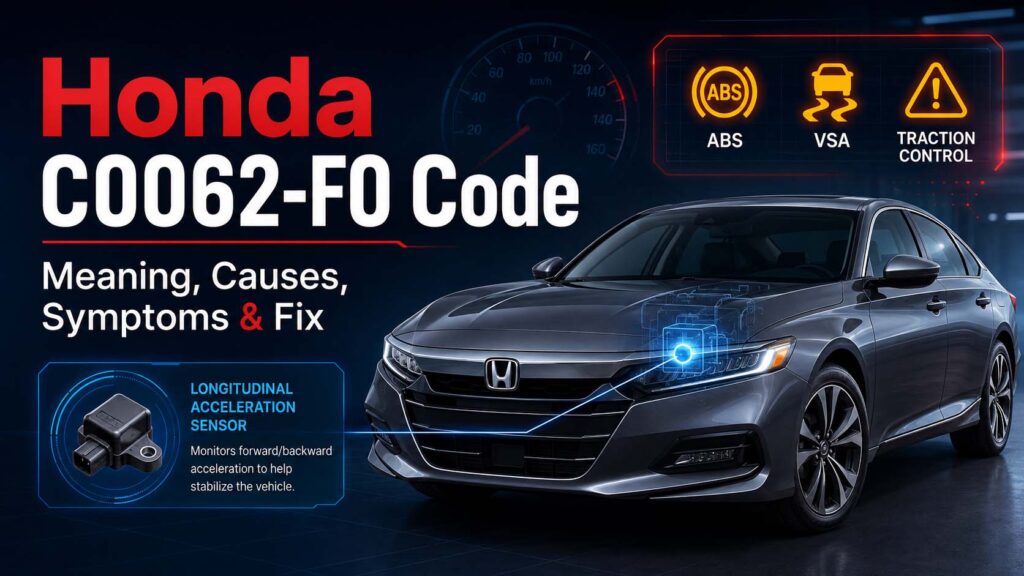
If your Honda shows the Honda C0062-F0 trouble code along with ABS, VSA, traction-control, or stability-control warning lights, the problem is usually related to the vehicle’s longitudinal acceleration sensor circuit or signal.
This sensor helps the Vehicle Stability Assist system understand how quickly the vehicle is accelerating or slowing down. However, if the signal becomes implausible, stuck, or unavailable, the stability-control system may disable some functions and store a diagnostic trouble code.
Honda service information for several models identifies longitudinal acceleration sensor faults as part of the ABS/VSA system. On some Honda vehicles the sensor is built into the VSA modulator-control unit, while on others it may be part of a separate yaw rate/acceleration sensor assembly.
Table of Contents
What Does Honda Code C0062-F0 Mean?
C0062 is generally associated with a longitudinal acceleration sensor fault.
The longitudinal acceleration sensor measures acceleration and deceleration along the vehicle’s forward-and-backward axis. The VSA/ABS control unit uses this information together with wheel-speed, steering-angle, yaw-rate, and lateral-acceleration data.
As a result, if the control module detects a signal that is stuck, outside the expected range, or inconsistent with vehicle movement, it can store a fault and illuminate the ABS or VSA warning lights.
Honda service information uses related manufacturer-specific DTCs such as 28-21, 28-22, and 28-12 for longitudinal acceleration sensor output or stuck-sensor faults, depending on model and year.
Common Symptoms of C0062-F0
A Honda with this fault may show one or more of the following symptoms:
- ABS warning light
- VSA or stability-control warning light
- Traction-control light
- “Check VSA System” message
- Stability control temporarily disabled
- Traction control not operating normally
- Code returning immediately after being cleared
- No obvious drivability problem in normal straight-line driving
In many cases, the engine itself still runs normally because the fault belongs to the chassis/stability-control system rather than the engine-management system.
What Causes Honda C0062-F0?
The exact cause depends on the Honda model, year, and sensor configuration, but common possibilities include:
1. Faulty Longitudinal Acceleration Sensor
For example, the sensor itself can fail internally or become stuck at one value.
Honda troubleshooting procedures for related faults instruct technicians to monitor the longitudinal acceleration sensor in live data while accelerating and braking. Therefore If the value does not change when the vehicle moves, the sensor or the assembly containing it may be faulty.
2. Fault Inside the VSA Modulator-Control Unit
On some Honda models, the longitudinal acceleration sensor is built directly into the VSA modulator-control unit.
In that case , a sensor fault may require diagnosis of the modulator itself rather than replacement of a separate external sensor. Honda service information for some CR-V and Civic applications specifically notes that the longitudinal acceleration sensor is located inside the VSA modulator-control unit.
3. Sensor Calibration or Neutral-Position Problem
In Addition Some Honda stability-control sensors require a neutral-position memorization or calibration procedure after certain repairs, component replacement, alignment work, battery-related events, or control-unit changes.
Related Honda VSA procedures show that sensor neutral-position memorization is part of diagnosis for certain yaw-rate and acceleration-sensor faults.
4. Wiring or Connector Problems
Similarly, A loose connector, damaged wire, corrosion, poor ground, or unstable voltage can create an incorrect sensor signal.
Furthermore Honda has also warned that poor electrical grounds can cause systems such as VSA to malfunction and generate difficult-to-diagnose DTCs.
5. Low Battery Voltage or Charging-System Issues
In some cases , Low system voltage can sometimes trigger multiple ABS/VSA codes at the same time.
Therefore , If the C0062-related fault appears together with voltage or power-supply DTCs, check battery condition and charging voltage before replacing expensive VSA components.
6. Vehicle Alignment or Tire Issues
Moreover, on certain Honda VSA systems, incorrect tire size, uneven tire wear, improper tire pressure, or wheel-alignment problems can affect stability-control diagnosis.
Honda service procedures for related VSA sensor faults specifically include checking tire condition and alignment.
Where Is the Longitudinal Acceleration Sensor Located?
The location is not the same on every Honda.
Depending on model and year, the sensor may be:
- integrated into the VSA modulator-control unit
- part of a combined yaw-rate/acceleration sensor
- mounted separately near the center of the vehicle
For this reason, you should not order a sensor based only on the C0062-F0 code.
For a detailed location guide, see:
Internal link suggestion:
Longitudinal Acceleration Sensor Location Guide
How to Diagnose Honda C0062-F0
A proper diagnosis is better than replacing parts immediately.
Step 1: Scan the ABS/VSA System
Use a scan tool capable of reading Honda ABS/VSA codes, not just basic engine codes.
First, use a scan tool capable of reading Honda ABS/VSA codes, not just basic engine codes.
Record:
- all stored codes
- freeze-frame data
- related voltage codes
- wheel-speed sensor codes
- yaw-rate or lateral-acceleration sensor codes
Honda service procedures recommend recording freeze data and on-board snapshots before clearing VSA DTCs.
For model-specific procedures and DTC troubleshooting, refer to Honda’s official Service Express information and the applicable Honda VSA service documentation.
Honda’s official Service Express information
Honda VSA service documentation
Step 2: Clear the Code and Recheck
Next, Clear the code, cycle the ignition, and road-test the vehicle safely.
If the code does not return, the fault may have been intermittent.
If it returns immediately, continue diagnosis.
Step 3: Check Live Sensor Data
Then, Look for a data parameter such as:
- Longitudinal Acceleration Sensor
- G Sensor
- Acceleration Sensor
- Yaw/Acceleration Sensor
When the vehicle accelerates and brakes, the value should change logically.
Honda’s troubleshooting procedure for a stuck longitudinal acceleration sensor specifically checks whether the sensor value changes during acceleration and braking.
Step 4: Inspect Wiring and Grounds
After That Check:
- connector security
- corrosion
- damaged wiring
- poor grounds
- signs of water intrusion
- recent body or repair work near the sensor or VSA module
Step 5: Check Battery and Charging Voltage
In Addition A weak battery can create misleading electronic faults.
As a basic check:
- engine off: battery should generally be around 12.4–12.7 V when healthy and charged
- engine running: charging voltage is commonly around 13.5–14.8 V
Exact acceptable values depend on the vehicle and charging strategy.
Step 6: Perform VSA Sensor Calibration if Required
If the sensor or VSA system needs neutral-position memorization, use a capable scan tool or Honda HDS-equivalent procedure.
Do not assume calibration alone will fix a genuinely failed sensor.
Can You Drive With Honda C0062-F0?
The car may still move normally, but the ABS, traction-control, or stability-control system may not operate fully while the fault is active.
That means the vehicle can have reduced electronic assistance during emergency braking, hard acceleration, slippery-road conditions, or sudden steering maneuvers.
It is better to diagnose the fault rather than ignore it, especially if the ABS or VSA warning lights remain on.
Does Honda C0062-F0 Always Mean the Sensor Must Be Replaced?
No.
Possible fixes can include:
- repairing wiring
- cleaning or securing a connector
- correcting a ground problem
- fixing a battery or charging issue
- performing VSA sensor calibration
- correcting tire or alignment problems
- replacing a separate yaw/acceleration sensor
- replacing or repairing the VSA modulator-control unit on models where the sensor is integrated
The correct repair depends on what the scan data and Honda-specific troubleshooting reveal.
How Much Does It Cost to Fix C0062-F0?
The cost can vary widely.
A simple calibration or wiring repair can be relatively inexpensive. A separate sensor replacement costs more, while a VSA modulator-control unit can be significantly more expensive.
Before approving a costly repair, confirm:
- the exact Honda model and year
- whether the sensor is separate or integrated
- whether calibration has been attempted
- whether wiring and power supply have been tested
Frequently Asked Questions
What does C0062 mean on a Honda?
It generally points to a problem with the longitudinal acceleration sensor signal used by the ABS/VSA stability-control system.
Can a weak battery cause C0062-F0?
Low or unstable voltage can contribute to ABS/VSA faults, especially when several chassis or voltage codes appear together. The battery and charging system should be checked before replacing expensive components.
Can C0062-F0 be fixed by calibration?
Sometimes, if the problem is related to sensor neutral-position learning. However, calibration will not repair a sensor that has failed internally.
Is the longitudinal acceleration sensor the same as the yaw sensor?
Not exactly. They measure different types of vehicle movement, although on many vehicles they are combined into one sensor assembly or integrated into the same VSA control unit.
Will clearing the code fix the problem?
Only if the fault was temporary. If the sensor signal remains abnormal, the code will return after the vehicle is driven or the VSA system performs its self-check.
Final Thoughts
Honda C0062-F0 should be treated as a VSA/ABS sensor-system fault, not as an automatic instruction to replace one specific component.
Start by scanning the full VSA system, checking related codes, watching longitudinal acceleration live data, inspecting power and wiring, and confirming whether your Honda uses a separate sensor or an integrated VSA modulator sensor.
That approach can prevent unnecessary parts replacement and makes it much easier to identify whether the real problem is the sensor, calibration, wiring, voltage supply, or the VSA control unit.