Honda C0062-F0 Code: Meaning, Causes, Symptoms & Fix
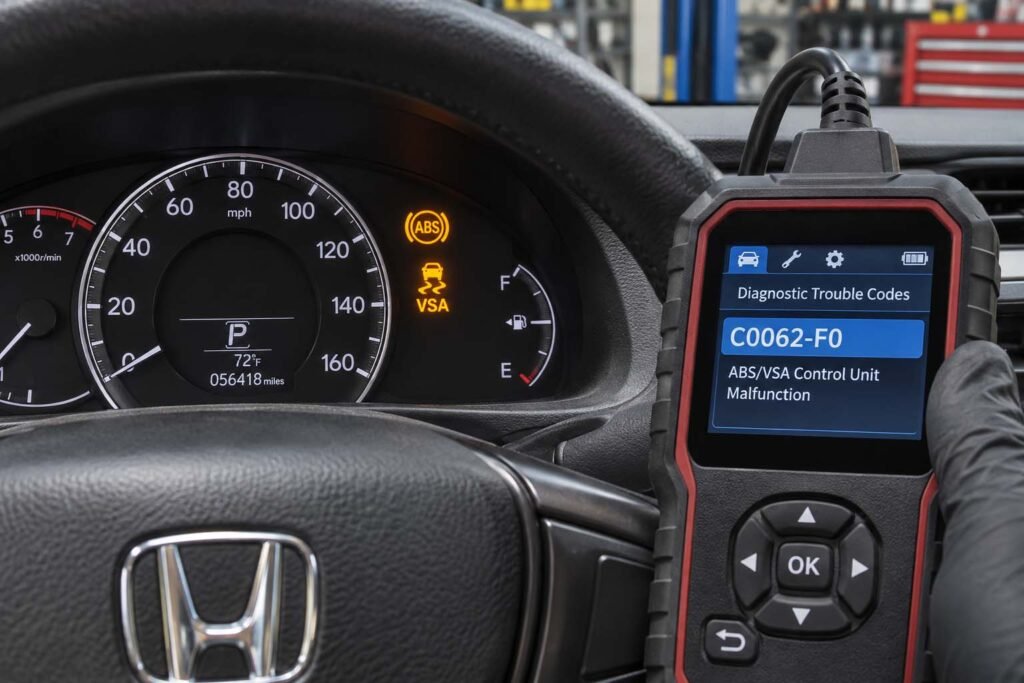
If your Honda displays the Honda C0062-F0 code together with ABS, VSA, or traction-control warning lights, the problem is usually related to the vehicle’s stability-control system and the sensor information it uses to determine vehicle movement.
However, diagnosing this code correctly is important before replacing any components. Depending on the Honda model, model year, and diagnostic system, the exact definition and subcode information can vary.
Therefore, the best approach is to confirm the complete fault code with a Honda-capable diagnostic scanner and inspect the related VSA system before replacing a sensor or control module.
In this guide, we explain what the Honda C0062-F0 code may indicate, the common causes and symptoms, and how to diagnose and repair the problem correctly.
What Does the Honda C0062-F0 Code Mean?
The vehicle’s ABS/VSA stability-control system may store the Honda C0062-F0 code when it detects abnormal sensor or system information.
Therefore Modern Honda vehicles use several sensors to understand how the vehicle is moving. Depending on the model, the system may monitor information such as:
- longitudinal acceleration
- lateral acceleration
- yaw rate
- steering angle
- individual wheel speed
- brake pressure
- vehicle speed
In addition, the VSA control system compares this information to determine whether the vehicle is following the driver’s intended direction.
If the control unit receives an implausible signal, loses communication with a sensor, detects an electrical problem, or determines that a sensor value is outside the expected range, it may store a diagnostic trouble code.
As a result, the ABS, VSA, traction-control, or stability-control warning lights may appear on the dashboard.
Is Honda C0062-F0 Always a Bad Acceleration Sensor?
No.
Therefore, do not assume that an acceleration sensor needs replacement simply because the Honda C0062-F0 code appears.
For example, similar VSA-related faults can sometimes be caused by:
- low battery voltage
- charging-system problems
- loose electrical connectors
- damaged wiring
- sensor installation problems
- communication faults
- calibration or initialization issues
- a malfunctioning sensor
- a VSA modulator-control unit problem
Therefore, replacing a sensor without testing the system first can lead to unnecessary repair costs.
Common Causes of Honda C0062-F0
Several problems may contribute to a Honda C0062-F0 fault.
1. Acceleration or Motion Sensor Fault
For example, a VSA system sensor may develop an internal electronic fault and send incorrect information to the control module.
Generally Depending on the Honda model, acceleration and yaw information may come from a dedicated sensor assembly or may be integrated differently into the stability-control system.
If the sensor provides incorrect or unstable information, the VSA module may store a fault.
2. Loose or Damaged Electrical Connector
In addition A loose connector can interrupt communication between the sensor and the VSA control system.
For example, vibration, previous repairs, moisture, or corrosion can affect connector terminals.
Therefore, connectors should be inspected before expensive components are replaced.
Look for:
- loose terminals
- bent pins
- corrosion
- moisture
- damaged connector locks
- partially disconnected plugs
3. Damaged Wiring
However, the sensor may work correctly while damaged wiring prevents its signal from reaching the control module.
Generally Possible wiring problems include:
- broken wires
- open circuits
- short circuits
- damaged insulation
- corrosion
- poor ground connections
- wiring damaged during previous repairs
In addition, intermittent wiring faults may cause the warning lights to appear only occasionally.
4. Low Battery Voltage
In addition, low system voltage can affect the ABS and VSA electronics.
However A weak battery, charging-system fault, or unstable voltage may cause multiple control modules to store diagnostic codes.
For example, if the vehicle recently experienced a discharged battery, jump-start, slow starting, or alternator problem, battery and charging voltage should be checked before replacing sensors.
5. Sensor Installation Problem
Acceleration and yaw sensors depend on correct mounting and orientation.
If a sensor has been removed, replaced, or disturbed during previous repairs, incorrect installation can affect its readings.
Therefore, check that the sensor and its mounting points are secure and installed according to the vehicle-specific service information.
6. Calibration or Initialization Issue
Additionally, after certain repairs, technicians may need to initialize, calibrate, or relearn the neutral position of some stability-control components.
For example, this may be necessary after work involving:
- VSA components
- certain sensors
- steering components
- control-module replacement
- alignment-related repairs
- battery or electrical work on some models
In addition, some vehicles may require a specific calibration procedure before the system can operate normally again.
Therefore, a Honda-capable scan tool may be required to perform the necessary procedure correctly.
7. VSA Modulator-Control Unit Problem
However, in less common cases, the VSA modulator-control unit itself may cause the fault.
Therefore, check the wiring, connectors, voltage, sensor operation, and calibration requirements before replacing the module.
Symptoms of Honda C0062-F0
Generally The symptoms associated with Honda C0062-F0 can vary depending on the vehicle.
Common symptoms may include:
- ABS warning light
- VSA warning light
- traction-control warning light
- stability-control warning message
- multiple warning lights appearing together
- traction control becoming unavailable
- VSA system switching off
- code returning after being cleared
- intermittent warning lights
- no noticeable change in normal driving
In some cases, the vehicle may still drive normally even though part of the stability-control system has been disabled.
However, the warning should not be ignored because ABS and stability-control functions are important safety systems.
How to Diagnose Honda C0062-F0
Correct diagnosis should be performed before replacing any component.
Step 1: Scan the ABS/VSA System
Start with a diagnostic scanner capable of communicating with Honda ABS/VSA modules.
A basic engine-code reader may not provide all of the information required.
Record:
- the complete DTC
- all available subcodes
- current and stored codes
- related ABS/VSA codes
- freeze-frame or snapshot information if available
Do not clear the codes before recording them.
Step 2: Check for Additional Fault Codes
Honda C0062-F0 may not be the only stored code.
For example, additional voltage, communication, wheel-speed, steering-angle, or sensor-related codes can provide useful diagnostic clues.
Therefore, diagnose related codes together rather than treating each warning light as a separate problem.
Step 3: Check the Battery and Charging System
Inspect the vehicle’s electrical supply.
Check:
- battery condition
- battery terminals
- charging voltage
- ground connections
- signs of previous low-voltage events
If system voltage is unstable, repair the charging or battery problem before continuing.
Step 4: Inspect Wiring and Connectors
Inspect the relevant VSA sensor wiring and connectors.
Look for:
- loose connectors
- corrosion
- water intrusion
- damaged wiring
- broken terminals
- poor grounds
- signs of previous accident or interior repair work
If necessary, perform continuity and voltage tests using the correct wiring diagram for the specific Honda model.
Step 5: Check Sensor Data With a Scan Tool
Generally A Honda-capable scanner may allow you to view live ABS/VSA data.
However Depending on the vehicle, useful data may include:
- longitudinal acceleration
- lateral acceleration
- yaw rate
- steering angle
- wheel speeds
- brake pressure
With the vehicle safely positioned on a level surface, check whether the readings appear reasonable.
Then An abnormal or fixed value may help identify the affected circuit or sensor.
Step 6: Confirm Sensor Installation
If the affected sensor has previously been removed or replaced, confirm that it is mounted correctly.
Although Loose mounting bolts, incorrect orientation, or improper installation can affect sensor readings.
Step 7: Perform Required Calibration
If the service procedure requires calibration or initialization, perform it using a compatible Honda diagnostic tool.
However After calibration:
- clear the stored DTCs
- restart the vehicle
- road-test the vehicle safely
- scan the system again
If the Honda C0062-F0 code returns, continue diagnosis according to the model-specific service procedure.
Where Is the Honda Acceleration Sensor Located?
However The exact sensor location depends on the Honda model, year, and VSA system design.
Additionally On some Honda vehicles, a yaw-rate/lateral-acceleration sensor is mounted inside the passenger compartment around the center-console or floor area.
However, this should not be treated as a universal location for every Honda.
Then Newer vehicles may use different sensor arrangements or integrate motion-sensing functions into other modules.
Therefore, always verify the exact location using service information for your specific:
- Honda model
- model year
- engine or drivetrain
- market specification
- VSA/ABS system
Do not remove interior components based only on a generic sensor-location diagram.
Can I Fix Honda C0062-F0 Myself?
Therefore Some preliminary checks can be performed without replacing components.
In addition You may be able to:
- inspect the battery
- check battery terminals
- inspect visible wiring
- inspect connectors
- scan the ABS/VSA system
- check whether the code returns after clearing
However, more advanced diagnosis may require:
- Honda HDS or a compatible scan tool
- wiring diagrams
- live sensor data
- calibration procedures
- electrical testing
- VSA system service information
If you are not comfortable diagnosing ABS or stability-control systems, professional diagnosis is recommended.
Should You Replace the Sensor Immediately?
No.
Replacing the acceleration or yaw sensor immediately is not recommended unless testing confirms that the sensor is faulty.
First, check:
- battery and charging voltage
- related DTCs
- wiring
- connectors
- live sensor data
- sensor mounting
- required calibration procedures
Only after these checks should sensor replacement be considered.
This approach reduces the risk of replacing an expensive component unnecessarily.
What Happens After Replacing the Sensor?
However, Depending on the Honda model, replacement may require a calibration, initialization, or neutral-position procedure.
After completing the repair:
- verify all connectors are secure
- perform any required calibration
- clear the ABS/VSA DTCs
- restart the vehicle
- road-test the vehicle
- scan the system again
If Honda C0062-F0 does not return and the warning lights remain off, the repair was likely successful.
Can You Drive With Honda C0062-F0?
The vehicle may still be drivable, but the ABS, traction-control, or VSA system may not operate normally while the fault is present.
Therefore, extra caution is recommended.
If the vehicle also shows:
- brake-system warnings
- abnormal braking
- steering problems
- multiple electrical warnings
- reduced braking performance
the vehicle should be inspected immediately.
Do not rely on stability-control or traction-control functions while the system displays a fault.
How Much Does It Cost to Fix Honda C0062-F0?
Although The repair cost depends on the actual cause.
A simple repair may involve:
- cleaning a connector
- repairing damaged wiring
- correcting a loose connection
- replacing a weak battery
More expensive repairs may involve:
- replacing a sensor
- performing calibration
- replacing or repairing VSA components
- professional diagnostic labor
Therefore, accurate diagnosis is the best way to avoid unnecessary parts replacement.
Frequently Asked Questions
What does Honda C0062-F0 mean?
Honda C0062-F0 is associated with a fault detected by the vehicle’s ABS/VSA stability-control system. The exact interpretation can vary by Honda model and model year, so the complete code and subcode should be checked using Honda-specific service information.
Can a weak battery cause Honda C0062-F0?
Low or unstable voltage can cause ABS/VSA-related faults. Therefore, the battery and charging system should be checked during diagnosis, especially if the vehicle has recently experienced starting or electrical problems.
Does C0062-F0 mean the acceleration sensor is bad?
Not necessarily. Wiring, connectors, voltage problems, sensor installation, calibration, communication faults, or VSA control-unit problems may produce similar symptoms.
Where is the longitudinal acceleration sensor located on a Honda?
The location varies by model and year. Some Honda VSA sensor assemblies are located inside the passenger compartment near the center-console or floor area, but you should confirm the exact location for your specific vehicle before removing components.
Can I clear Honda C0062-F0 with a scanner?
Yes, a compatible scanner may clear the stored code. However, if the underlying fault remains, Honda C0062-F0 will usually return.
Does the sensor need calibration after replacement?
Depending on the vehicle and repair procedure, calibration or initialization may be required. Always follow the service information for the specific Honda model.
Can one VSA sensor cause multiple warning lights?
Yes. Because the VSA, ABS, and traction-control systems share information, one sensor or circuit fault can cause several related warning lights to appear.
Final Thoughts
The Honda C0062-F0 code should be diagnosed carefully rather than treated as an automatic sensor-replacement code.
However Start by scanning the complete ABS/VSA system, checking the battery and charging system, inspecting wiring and connectors, and reviewing live sensor data.
In addition, confirm that the relevant sensor is correctly installed and perform any required calibration procedures.
Finally, if testing confirms that the sensor or VSA component is faulty, replace the affected component according to the Honda service procedure and verify the repair with a road test and another diagnostic scan.
A systematic diagnosis can prevent unnecessary parts replacement and help restore the ABS and VSA system correctly.